By Tess Wrobleski, in conversation with WA CoCoRaHS observer Laurie Pitman
“I think of CoCoRaHS like the nerves under a person’s skin. Dozens of nerves are useful, but THOUSANDS of nerves give you so much better feedback.”
Every morning, Laurie Pitman takes her border collie, Emma, outside. While Emma chases birds, Pitman checks the rain gauge located on the top of her fence post. She brings her face to eye level with the measuring tube, and notes where the water line falls. Back in December, during the atmospheric river and flood event, she measured almost 3.5” of rainfall. Pitman records the measurement in an app on her phone, and snaps a picture for her own records. Then, she empties the tube of rain water — preparing the gauge for another day of recording.
The process takes roughly 2 minutes, but this relatively straightforward task provides a critical data point for the Community Collaborative Rain, Hail and Snow Network.
Pitman, a retired pilot and self-described “skywatcher,” has been contributing to the precipitation network (also called CoCoRaHS), since 2009. She began as a volunteer in Oakland, California, and remained part of the network when she moved to Kitsap County in 2020. CoCoRaHS is an international network, spanning the U.S., Canada and U.S. territories. In Washington, CoCoRaHS is managed by the Washington State Climate Office.
As one of thousands of CoCoRaHS volunteers in the network nationwide, Pitman reports daily backyard precipitation measurements to support the work of meteorologists, hydrologists, water managers and many others. On a day-to-day basis, the data Pitman and others collect help verify weather forecasts and improve weather and flood warnings. On a long-term basis, the measurements inform how communities and regions plan for extreme weather, drought, and flooding events. These data points can also help improve and check the accuracy of climate models.
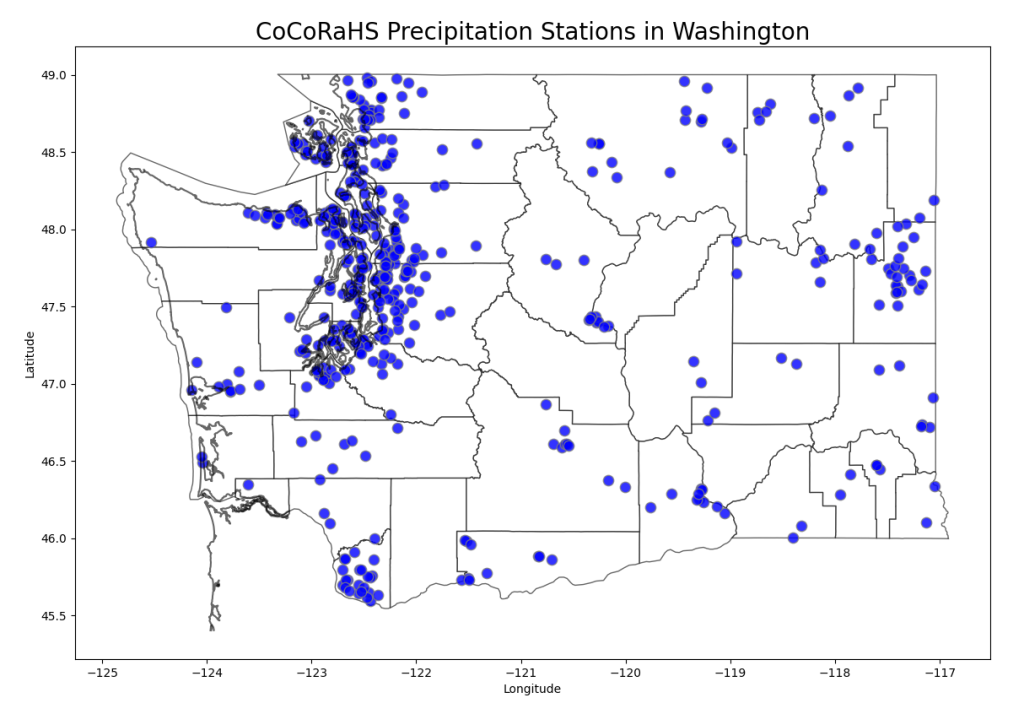 Map of active CoCoRaHS Observers as of 2025. The Washington State Climate Office serves as the statewide coordinator of the CoCoRaHS Program.
In her 16 years as a volunteer, Pitman has likely contributed more than 5,500 data points to the CoCoRaHS Network. And though Pitman’s site alone can’t tell us much, “one site along with hundreds of my neighbors gives an impressive picture of changing weather patterns,” she says.
Recently, we spoke with Pitman about her work with CoCoRaHS and why she has volunteered with us for well over a decade.
Q: Why did you choose to join CoCoRaHS as a volunteer? What interested you about the program?
A: I love meteorology; I even considered studying it seriously. As a retired pilot, I understand the value of good, granular data. Living (and flying) in the Bay Area for 30 years taught me how important our understanding of microclimates is. Contributing rain data seemed like a valuable thing to do.
Q: Can you tell us a little more about where you live in terms of the winter climate – is it cold and snowy? Rainy?
A: I live on the northwestern edge of Colvos Passage, across from Vashon Island. This part of the Puget Sound area has lots of hills and evergreen forests, although in the past 100 years it has become overrun with Himalayan blackberries, scotch broom, and deciduous trees like maple and poplar. Cedar doesn’t break down very quickly, so if you dig very far you’ll probably find the remains of a tree. The soil is sandy, replete with what we call “potato rocks,” chunks of glacier leftovers worn smooth and round. We do get a lot of rain, but — due to the sandy soil and the layers of decaying cedar wood — my property drains very well. This region doesn’t suffer often from flooding.
It snows once or twice in January or February, but it doesn’t usually last more than a few days. Temperatures don’t often fall below freezing for more than a few days at a time. It’s temperate enough that I have kale and arugula all winter long from under a plastic hoop house.
The climate in western Washington is changing. [Over] the last few years, we haven’t had any rain during the summer. This last year we went 90 days without appreciable precipitation. The weather here reminds me of what the Bay Area was like when I moved there in 1990.
Q: What do you enjoy about being a CoCoRaHS volunteer? Why do you keep volunteering?
A: I think it’s important to have and keep good records. I can say with confidence “Our climate is changing” because I can see how the data are different now from even five years ago. I think of CoCoRaHS like the nerves under a person’s skin. Dozens of nerves are useful, but THOUSANDS of nerves give you so much better feedback.
Q: What do you do outside of CoCoRaHS, for work or for fun?
A: I’m retired now, so no more work, but lots of other activities. My border collie Emma keeps me busy. In fact, she is pestering me right now because I’ve been sitting at the computer too long. I play the piano and the concertina, I garden, I clear out blackberries and scotch broom, I build things, I keep hens, I write, I read, I am a member of the working board of a non-profit in the Bay Area.
Q: What would you say to someone who is considering volunteering?
A: Your community will thank you! Recording the rain daily is a habit you can be proud of.
CoCoRaHS is currently accepting volunteers! We welcome volunteers from all over Washington, but are especially recruiting volunteers from eastern Cascades, Columbia Basin, and the Coast and Olympic Peninsula.
If you are interested in becoming an observer, visit the CoCoRaHS website to learn more, purchase a rain gauge, access training materials, and register with the program to start reporting your observations.
Please direct any questions about the Washington CoCoRaHS program to wash.cocorahs@gmail.com. We are here to help!
If you are already an observer, we encourage you to recruit your friends, family and neighbors! Even local schools can access educational materials to implement an observation program.