By Karin Bumbaco
With Washington’s statewide snowpack as of March 5th ranking as the 3rd lowest since modern records began in 1985, questions have been coming into WASCO regarding the potential impacts on spring and summer streamflow. Many of our rivers in Washington have at least some contribution from snowmelt in the spring, but just how much does snowpack matter for river flow?
To answer that question, I examined the relationships between basin-average April 1 snow water equivalent (SWE/snowpack) and monthly average streamflow for a handful of rivers in Washington. Instead of presenting correlations, I’m showing the slope of the best fit line to show how much actual influence snowpack has on flow on each river each month – this gets at the idea of the “effect size”.
The plot below shows the percentage change in streamflow for each percentage change in snowpack. I divided the monthly streamflow totals by the April-September average flow so that we could compare different rivers side-by-side. In the graph below, stars represent slopes that are statistically significant at the 95% confidence level. Put another way, the stars show where this relationship is unlikely to be due to chance.
 Relationship between April 1 SWE and summer streamflow by month. Stars represent statistically significant relationships.
These positive slopes mean that when April 1 snowpack is high, spring streamflows are also high, and vice versa. For the Wenatchee, Dungeness, and Snohomish Rivers, April 1 snowpack has the strongest relationship with June streamflow. The influence of spring snowpack on May and June streamflow is the largest on the Wenatchee, but that river also experiences the steepest drop in effect of snowpack in July, August, and September. The Sauk River behaves a little differently from the other three with the largest influence in July. This is not surprising considering the Sauk watershed includes some of the highest elevations of the North Cascades and can therefore take longer to melt out compared to lower elevation basins.
All of these rivers follow a general pattern of declining snowpack influence by late summer. This is especially true for the Snohomish River on the west side of the Cascades. August and September streamflows are not greatly influenced by spring snowpack. This means that late summer precipitation is likely more important for flows at that time of year for all of the example rivers.
I also calculated the best fit slopes between cool season (October-March) precipitation (both rain and snow) and monthly average streamflow for the same rivers.
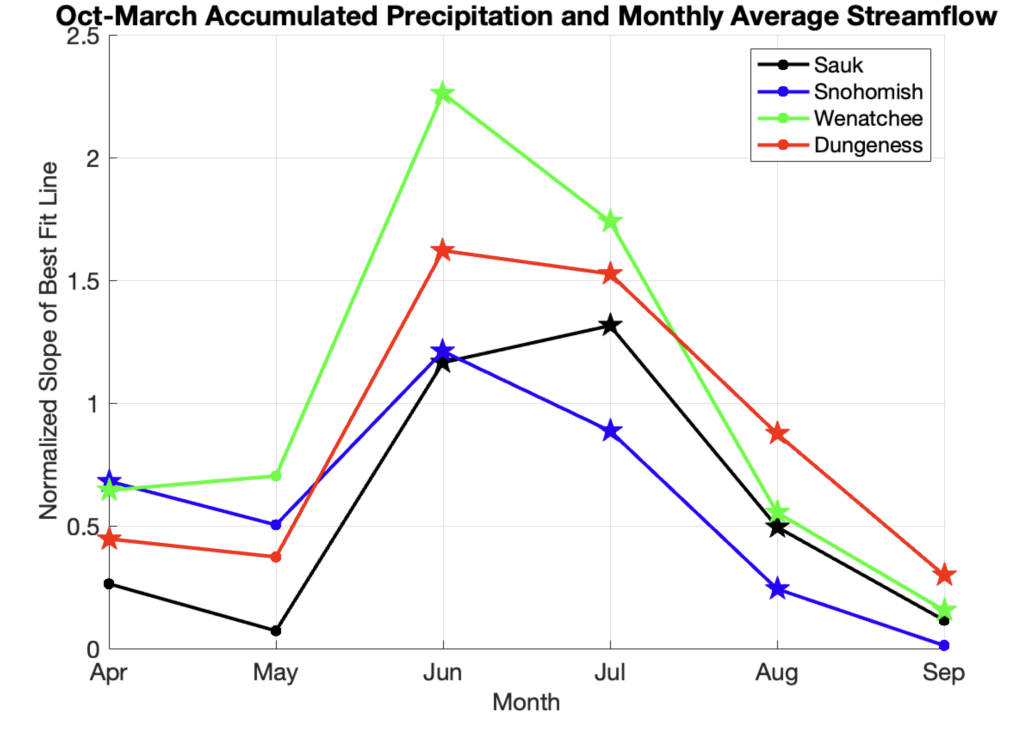 Relationship between October-March precipitation and summer streamflow by month. Stars represent statistically significant relationships.
Perhaps surprisingly, October through March total precipitation has a statistically significant relationship with streamflows all the way out to August on all of the chosen rivers, particularly on the Wenatchee and the Dungeness. This is likely a reflection of the importance of snowpack, since you can’t have snow without precipitation.
The raw datasets used for the computations in this piece show that on average, total Oct-Mar precipitation and April 1 snowpack are well-correlated with each other (r=0.7) across the 14 basins NRCS provides snowpack summaries for. Precipitation and snowpack are most highly correlated in the Upper Columbia basin (r=0.8) and least correlated in the Central Puget Sound basin (r=0.4). To really tease apart how fall and winter rainfall impacts spring and summer streamflow, we would need to also look at temperatures to separate rainfall from snowfall. Although not included in this analysis, we would expect to see that rainfall in Oct-March has less of an influence on spring and summer streamflows than precipitation in general.
Another interesting aspect of the early season precipitation graph is the modest relationship with April streamflow for all rivers, except the Sauk, and then the lack of relationship with May streamflows on all rivers. This can be interpreted as a shorter duration response in April streamflow to Oct-March precipitation that fades quickly and does not matter at all for May streamflow. In other words, May streamflow is likely much more responsive to April and May precipitation than what fell through March. Temperature is also likely to be particularly important in spring given that it determines both when and how much snow melts. The lack of relationship between Oct-March total precipitation on both April and May streamflow on the Sauk River again demonstrates the colder temperatures across this watershed, where the bulk of the melt occurs in later months.
This piece underscores the importance of mountain snow and why we are likely in for lackluster streamflows later this spring and summer, due to our much below normal snowpack (read our February 2026 Snowpack and Drought Summary for more information on our current snowpack). That said, other factors can be important. For example, the amount and timing of precipitation in spring and summer can sometimes be enough to at least partially offset the lack of snowmelt. Cooler than normal late spring and early summer temperatures can also delay snowmelt and improve summer flows, but warmer than normal temperatures have the opposite effect. In summer, precipitation is the most important factor because by then the bulk of the snow has melted. As of now, seasonal forecast models and the Climate Prediction Center indicate elevated odds of warmer than normal temperatures this summer and a slightly higher odds of below normal summer precipitation (see the Climate Outlook for spring conditions).
Data Used: In Detail
For this exploration, I downloaded monthly average streamflow for rivers in the Olympic Mountains, western Cascades, eastern Cascades, and in the Spokane basin from USGS that are in either mixed rain and snow basins or snow dominated basins. Mixed rain and snow basins tend to see high flows in both winter (during the wet season) and spring (during the snowmelt season). Snow dominated basins tend to see their highest flows during the spring snowmelt season. The rivers used in this analysis are the Dungeness River near Sequim, Sauk River near Sauk, Snohomish River near Monroe, and Wenatchee River at Monitor. I was careful to select “unregulated” rivers (i.e. not downstream of a dam), since dam operations would make it harder to isolate the effects of climate on flows.
I also obtained average April 1 snow water equivalent (SWE) from 1980 through 2025 for the fourteen Washington basins shown on the snowpack percent of median map from NRCS, along with total Oct-Mar accumulated precipitation for the same basins.
Although they don’t correspond exactly, I used the closest basin average April 1 SWE and total Oct-Mar precipitation for each stream gauge, to compute the correlations and the slopes of the line of best fit. Specifically, I used the Olympic basin SWE and precipitation for the Dungeness River; the North Puget Sound basin for the Sauk River; the Central Puget Sound basin for the Snohomish River; and the Central Columbia Basin for the Wenatchee River.