By Jacob Genuise
Key Messages:
- Temperatures were about 3-5°F above normal in the eastern half of the state and 1-3°F above normal in western Washington. Statewide, February ranked as the 24th warmest February since 1895.
- Precipitation was below normal across key snowpack regions including the Cascades, Olympics, and Okanogans. Statewide, February ranked as the 18th driest February since 1895.
- Winter 2026 (December-February) was tied with 2015 as the 4th warmest in Washington with much warmer than normal temperatures in virtually the entire U.S. West.
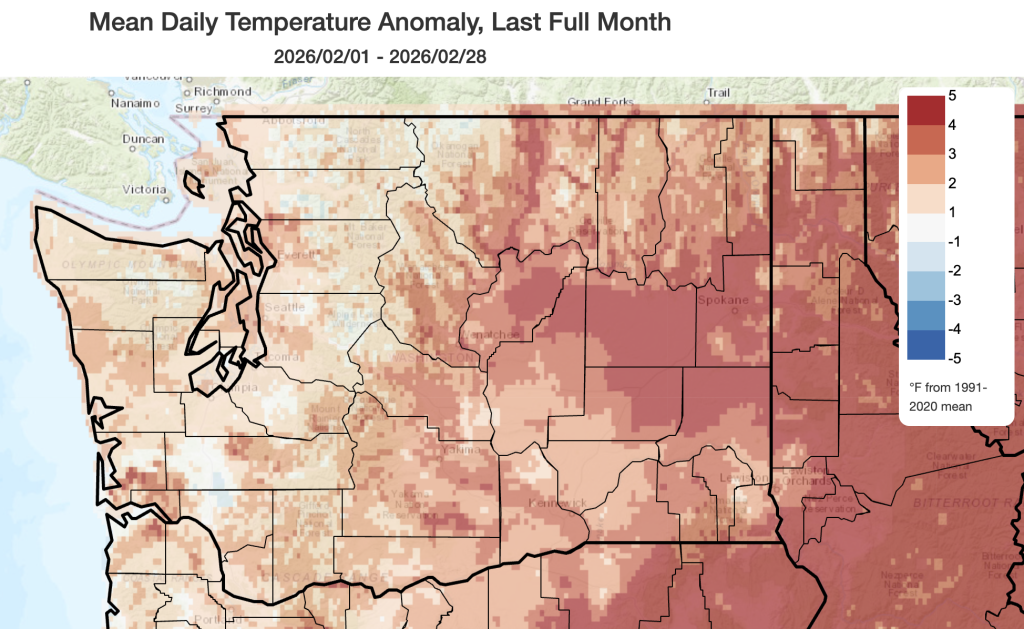 February 2026 mean temperatures compared to 1991-2020 normals.
Temperature: Temperatures were once again above normal across almost the entire state this February. Temperatures were +3-5°F above normal across portions of the Columbia Plateau, eastern Cascades, Blue Mountains, Okanogan Valley and near Spokane. This included temperatures +3.3°F above normal at Wenatchee, +3.6°F at Spokane, and +2.4°F at Pasco/Tri-Cities. Across the western Cascades and western Washington temperatures were generally 1-3°F above normal including +1.9°F at Seattle WFO and +1.0°F at Quillayute. Temperatures were near normal in small pockets near Puget Sound and the southern Chehalis River Basin.
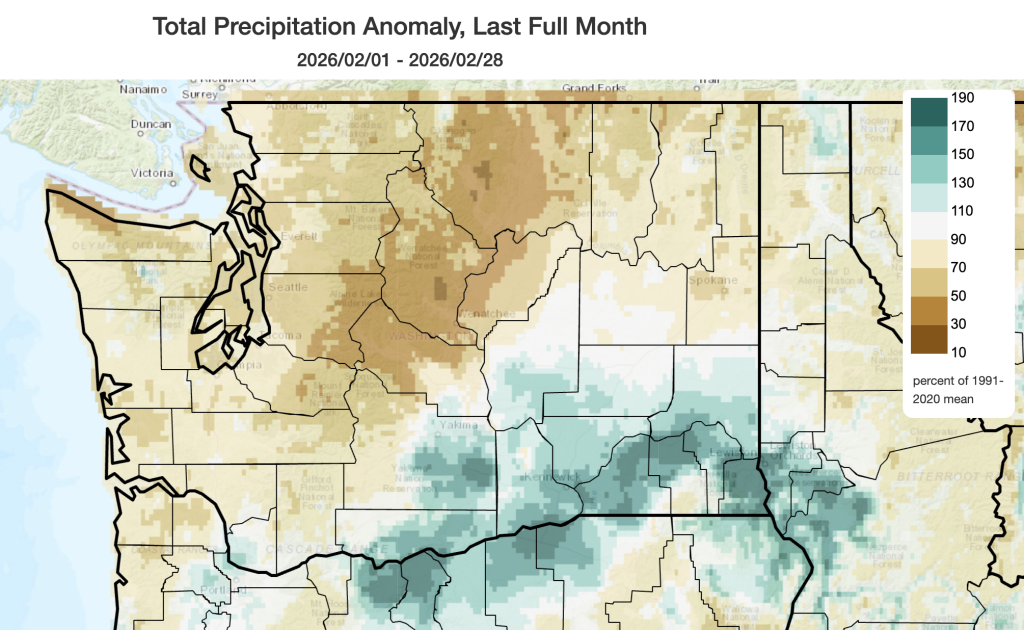 February 2026 precipitation as a percent of 1991-2020 normals.
Precipitation: Dry spells through the first half of the month led to below normal precipitation across key snowpack water resource regions including the Olympics, Cascades, and Kettle, Selkirk, and Okanogan ranges. Conditions were driest relative to normal across the eastern slopes of the central and northern Cascades where precipitation was below 50% of normal for the month. The Columbia basin from The Dalles/Dallesport through the Tri-Cities, Walla Walla, and Pullman received above normal precipitation largely thanks to a near-stationary atmospheric river late in the month that brought moisture into the southern portions of eastern Washington. Places like Pasco and Hanford saw about twice their usual monthly precipitation, but since they’re normally very dry, that amounted to only around an extra half inch to one inch of rain beyond their monthly normal precipitation. Locations further north such as Wenatchee, Spokane, and Omak recorded only around 50% of their normal monthly totals.
Warmer and drier than normal conditions during the month of February echoed similar conditions in January. These conditions during some of the most crucial snowpack building months of our cool season continued to limit opportunities for improvements in our snow drought.
 February 2026 climate summaries for select locations around Washington. Anomalies are relative to a climate normal baseline of 1991-2020.
Winter 2026 Climate Summary
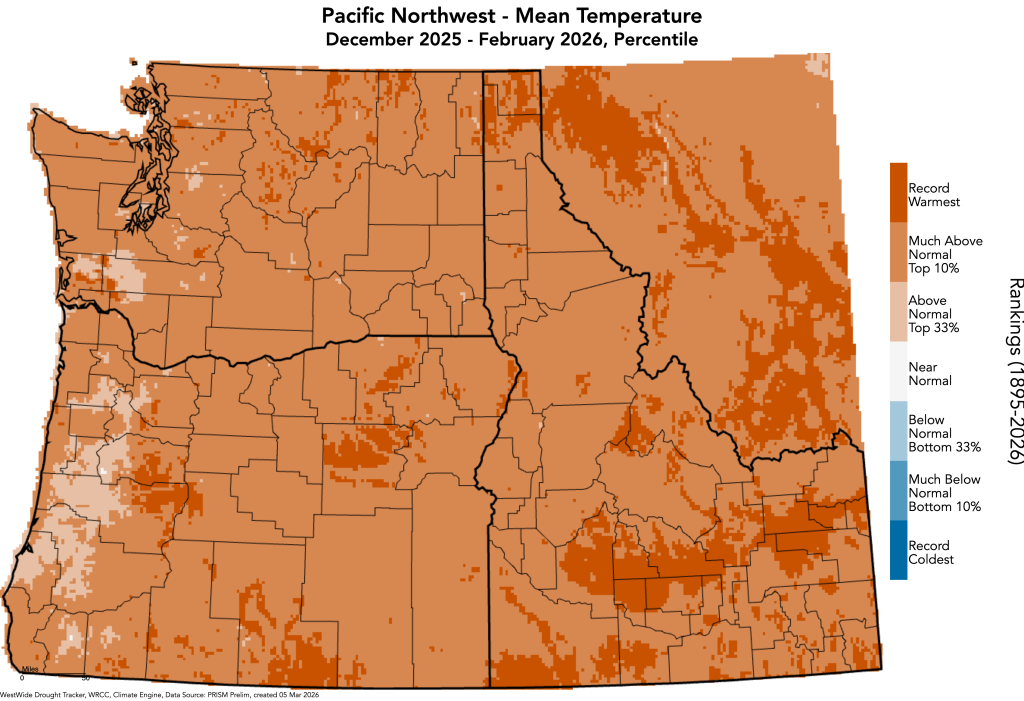 Winter (December-February) mean temperature percentiles in the Pacific Northwest.
The most remarkable feature of the December-February winter period has been record-breaking warmth. The state of Washington, the Pacific Northwest, and by and large the entire Western United States has experienced record or near-record breaking temperatures this winter which has contributed significantly to ongoing snow drought across the U.S. West.
For Washington, December-February was the warmest such period on record since at least 1895, and every month since November 2025 has featured above normal temperatures when averaged statewide. This consistent warmth over the winter was particularly unexpected given the presence of La Niña this year, which typically tilts the scales toward cooler conditions.
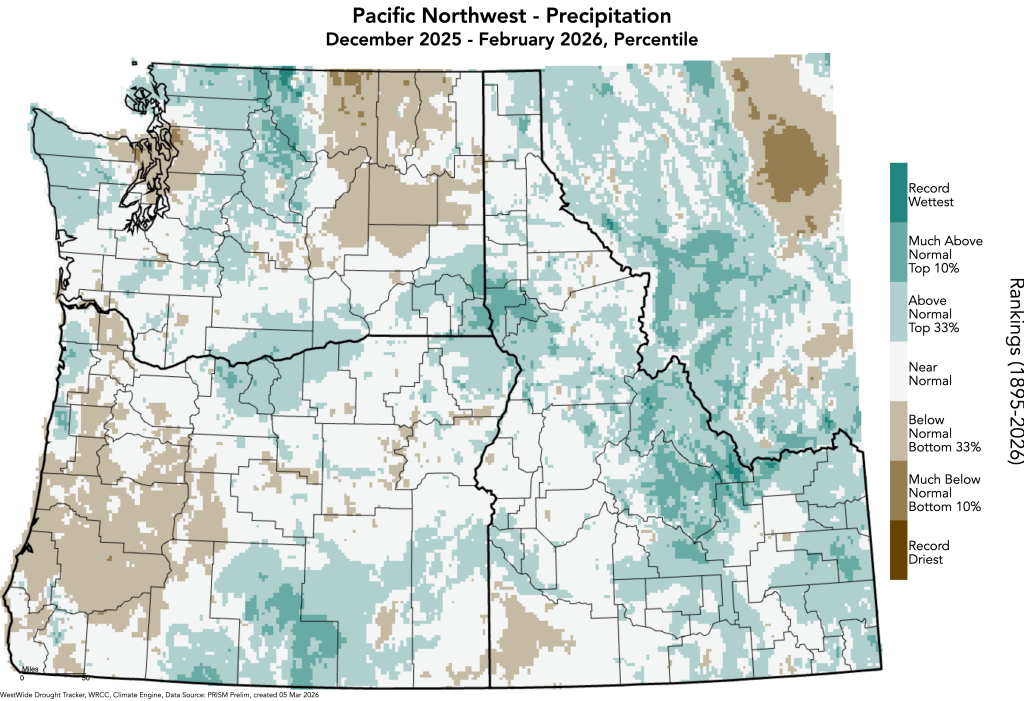 Winter (December-February) precipitation percentiles in the Pacific Northwest.
Precipitation this winter has been more mixed across the state. Wetter than normal conditions occurred across the coast and Olympics, the Central and northern Cascades, along the Columbia Gorge, and in the far southeast corner of the state. Despite these areas being wetter than normal, warm temperatures have meant too much of this precipitation has fallen as rain rather than snow. Drier than normal winter conditions occurred in central Puget Sound and the upper Columbia Plateau and the Okanogan valley and surrounding mountains.