By Karin Bumbaco
The sixth annual Pacific Northwest (PNW) Water Year Impacts Assessment provides a detailed evaluation of climate conditions and related impacts across Idaho, Oregon, and Washington during the 2025 water year (October 1, 2024–September 30, 2025).
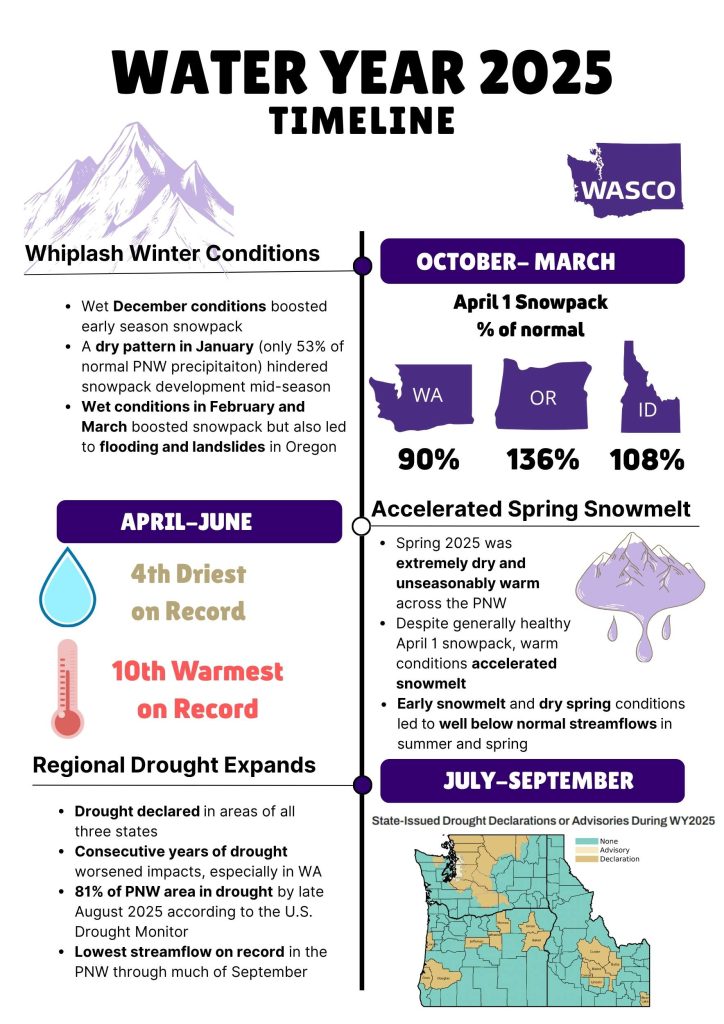
The 2025 water year was characterized by much warmer than normal temperatures and slightly below-normal precipitation, continuing a multi-year regional drought. Regionwide, the 2025 water year ranked as the 4th warmest and 38th driest in the 130-year historical record.
Early winter storms in November and mid-December delivered above-normal precipitation and solid early-season snowpack, but these gains were offset by a very dry January and an extremely warm and dry spring. Spring 2025 ranked among the 4th driest and 10th warmest on record across the region, accelerating snowmelt and causing substantially reduced spring and summer streamflows, especially in Idaho, eastern Washington, and western Oregon. As a result, drought expanded and intensified through late spring and summer, and all three states declared drought emergencies in affected areas.
Not only does the PNW Water Year Impacts Assessment outline the physical climate drivers of the 2025 drought, but it also synthesizes information from regional Water Year meetings, distributed surveys, and condition monitoring reports collected from partners and community observers to detail tangible impacts to various sectors such as agriculture, forestry, drinking water, fisheries, and recreation. Direct reports from those experiencing on-the-ground impacts are essential for understanding the full picture of drought impacts in our region.
Impacts on agriculture due to abnormally dry conditions were most frequently reported across eastern Washington (with the greatest number in Yakima County), the Idaho Panhandle, and Jefferson County, Oregon. Example impacts include less surface water and streamflow, increased plant stress, reduced crop yields, water right curtailment or reduced water allocation, and increased water demand; see the assessment for more details on this and other sectors. The report also details what actions people took in response to these impacts.
Read the Water Year 2025 Impacts Assessment
The report represents a collaboration between the Washington State Climate Office, University of Washington Climate Impacts Group, Oregon Climate Service, Oregon Climate Change Research Institute, and NOAA’s National Integrated Drought Information System.