By Nick Bond
A coastal ocean prediction system, named J-SCOPE, has been recently developed for the coastal waters of the Pacific Northwest. J-SCOPE has been designed to provide quantitative forecasts of physical, chemical and biological ocean properties on time horizons of up to 9 months. It represents a collaborative effort between researchers at the Joint Institute for the Study of the Atmosphere and Ocean (JISAO) and the Applied Physics Laboratory (APL) of the University of Washington, and at the Northwest Fisheries Science Center (NWFSC) of NOAA. The information from J-SCOPE is being used by NWFSC in its annual Integrated Ecosystem Assessment (IEA) for the waters of the Pacific Northwest. While a number of people have contributed to the development and implementation of J-SCOPE, Samantha Siedlecki of JISAO gets the lion’s share of the credit for making it a reality.
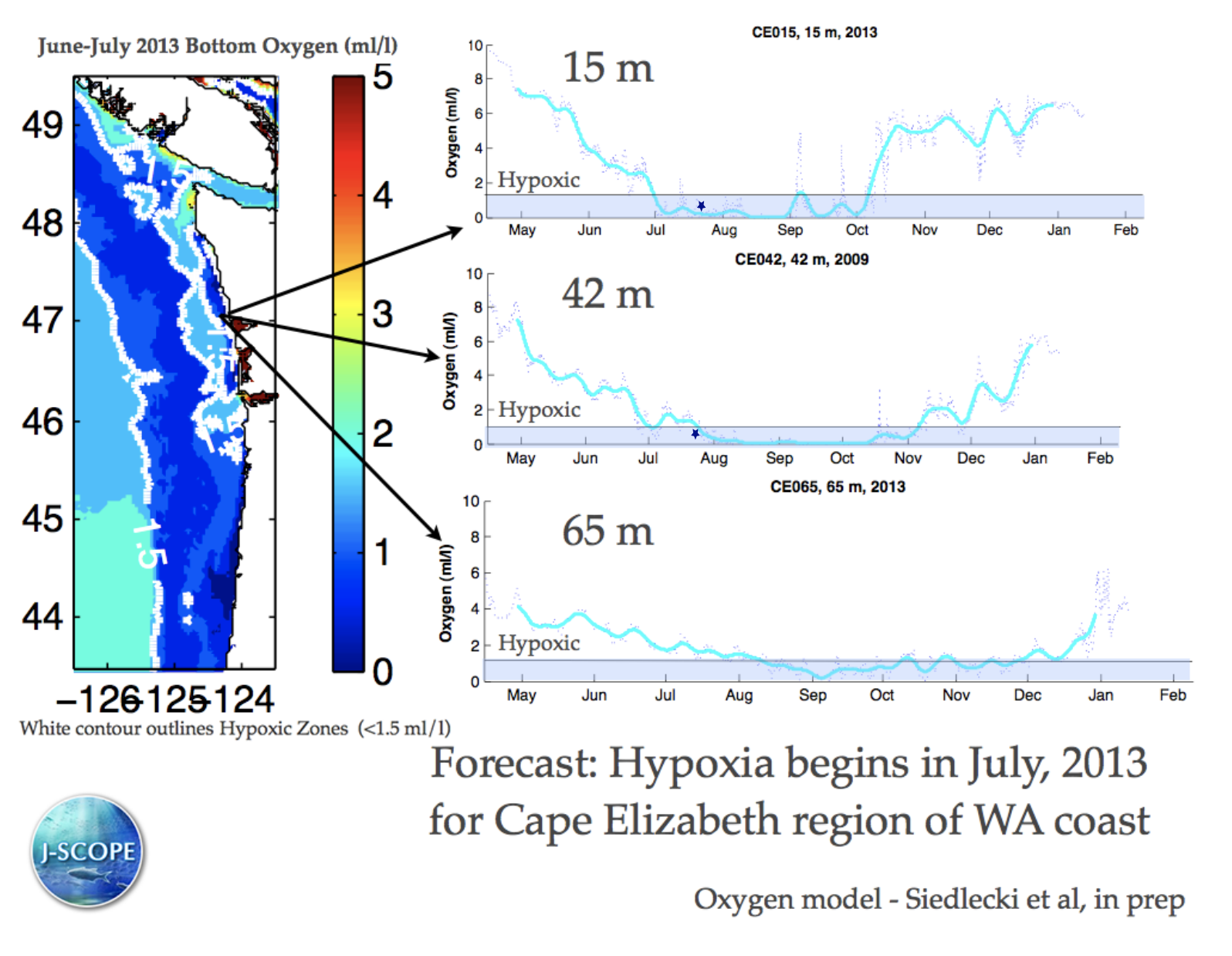 Figure 1: Oxygen concentrations (ml/liter) from the J-SCOPE model run of April 2013. The left panel indicates the distribution at near bottom depths for June-July 2013; the time series at the right show the projected declines in oxygen concentration at 3 depths in association with the up-welling winds of summer, and the recovery in fall. The stars on the forecasts for 15 and 42 meters represent observed values.
The J-SCOPE forecasts are based on numerical ocean model simulations using a high-resolution (grid spacing ~5 km) version of the Regional Ocean Modeling System (ROMS) with a biochemical component that simulates nutrient and oxygen concentrations and plankton distributions. The initial and boundary conditions for the ROMS runs are from the Coupled Forecast System (CFS), which is a global coupled atmosphere-ocean model that is run operationally by NOAA/NCEP/CPC for use in seasonal weather prediction (occasionally mentioned in the “Climate Outlook” section of this newsletter). More information on J-SCOPE is available at the following website: http://www.nanoos.org/products/j-scope/home.php. The projections from J-SCOPE are subject to limitations associated with the ROMS model, and by errors in the specification of the future large-scale forcing by the CFS. Nevertheless, the early results are promising, as illustrated below.
A sample set of J-SCOPE forecasts made in April 2013 is shown in Figure 1. Included here are time series of oxygen concentrations at three different depths, and a map of bottom oxygen concentrations for June-July 2013. Values less than 1.5 ml/liter, as signified on the map by the deeper blue colors, represent hypoxic (low oxygen) conditions stressful to many species. The model predictions were for hypoxia to form along the Washington coast sometime during July depending on depth, which is relatively early in the season. This projection turned out to be fairly accurate, as evidenced by measurements of oxygen concentrations from a moored buoy near Cape Elizabeth maintained by the Olympic Coast National Marine Sanctuary (shown with stars on the forecasts for the depths of 15 and 42 meters). In addition, there have been reports of unusually large numbers of dead Dungeness crabs on some Washington state beaches (Figure 2). The forecasts begun in February 2013 indicated a similar timing for the onset of hypoxia. Perhaps it was a case of beginner’s luck, but maybe it should be no surprise. As long as the climate forcing from the CFS is reasonably good, which has been found to be the case much of the time, ROMS should provide useful projections for the future chemical and biological states of our coastal waters.
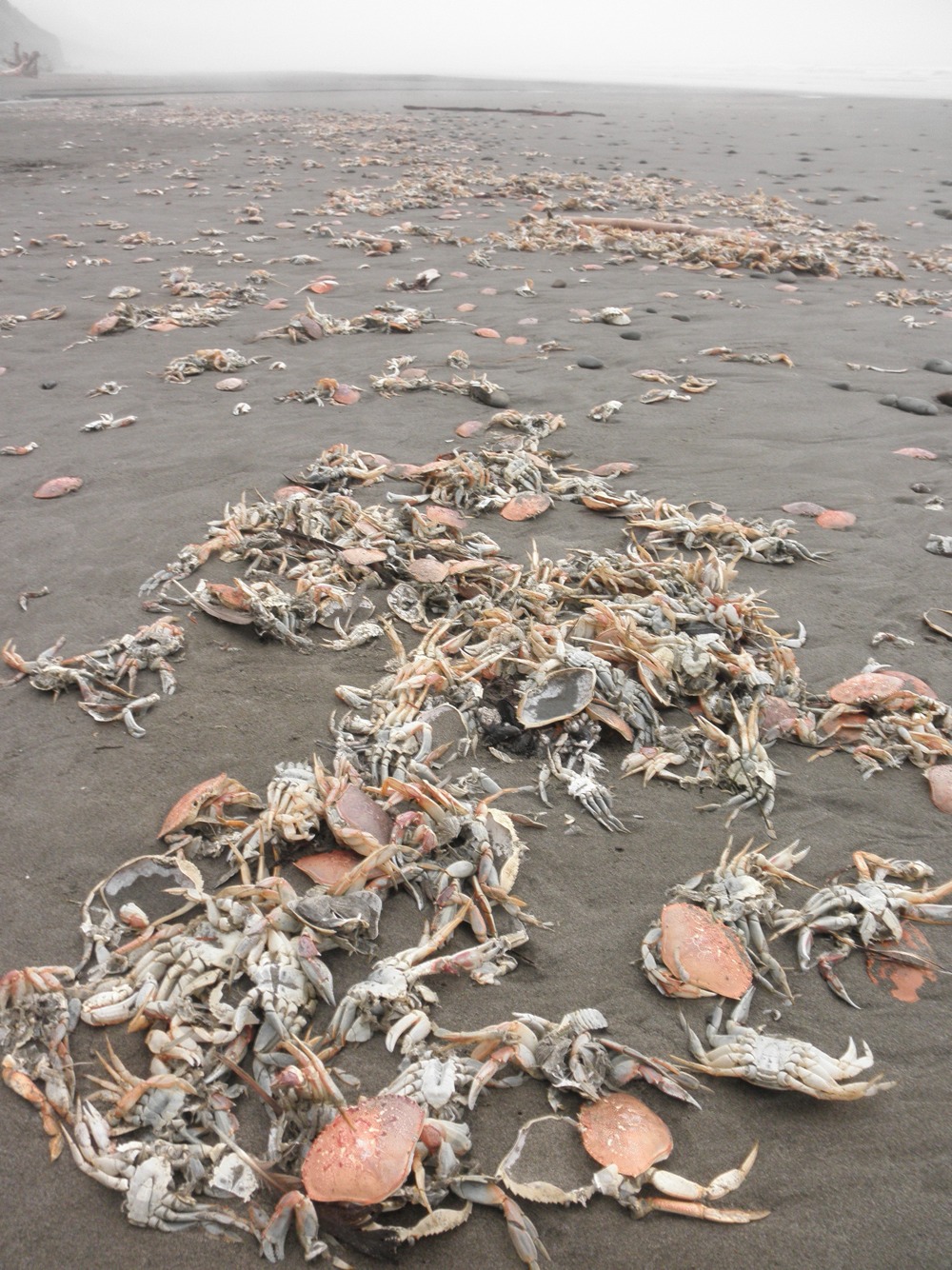 Figure 2: Dead crabs washed up on Washington coast near Ruby Beach on 15 August 2013 (Photo: Ellen Starr).
J-SCOPE is more of an experimental rather than operational forecast system. Its principals are keen on acquiring the financial support necessary to not just maintain it beyond 2013, but to enhance it. Based on hindcasts of past conditions, as well as the forecasts for the summer of 2013, it should be feasible to make predictions for the coastal waters of the Pacific Northwest in terms of their quality as a habitat for sardines and juvenile salmon, among other organisms higher in the food chain. This information should be valuable to a broad range of groups (tribes, commercial and recreational fishers, managers, conservation organizations, etc.) with marine interests.