By Nick Bond
There is a close association between the short-term climate variability of the Pacific Northwest and the Pacific Decadal Oscillation (PDO). The PDO is fundamentally a mode or pattern of North Pacific sea surface temperature variability; Figure 1 shows the monthly PDO index since about 1970. It is becoming increasingly evident that the PDO is much more a result than a cause of fluctuations in the atmospheric circulation over the North Pacific and North America, as detailed in the recent review by Newman et al. (2016). Nevertheless, because it co-varies with a variety of atmospheric and oceanic properties, it provides a convenient, if by no means complete, means of characterizing the climate variability of the Pacific Northwest. Despite its name, the PDO actually fluctuates over a wide range of time scales. In other words, while it became strongly positive about two years ago, perhaps we should pay attention to current forecasts of the PDO.
Can changes in the PDO actually be predicted with much reliability? The short answer: to a certain extent. The PDO is largely controlled by the Aleutian low, with a stronger than normal and southeast-displaced Aleutian low associated with a positive trend in the PDO and a weaker and more westward Aleutian low with the negative phase of the PDO. Therefore prediction of the PDO requires proper handling of forecasts of the Aleutian low, which itself is related to ENSO. Models that have skill at ENSO prediction consequently have some success at anticipating changes in the PDO. An example is NCEP’s Climate Forecast System (CFS) model. As shown in Figure 1 below from Wen et al. (2012), a comparison of forecasts with observations for the period of 1981 through 2007 indicates that the CFS is generally able to predict major shifts in the PDO. There is definitely a tendency for the model to play catch-up; as shown by the differences between the 3-month and 6-month forecasts, the CFS is often too slow in capturing major transitions in the PDO. Figure 2 pertains to PDO forecasts on a time horizon of up to 6 months. Additional research into the predictability of the PDO on time scales of a year and longer has been carried out, but this subject is not the focus of the present piece. Here it suffices to say that forecasts of the PDO beyond a year or two lack much if any skill, and that there appear to be fundamental limitations in long-term predictions of climate variations of this type.
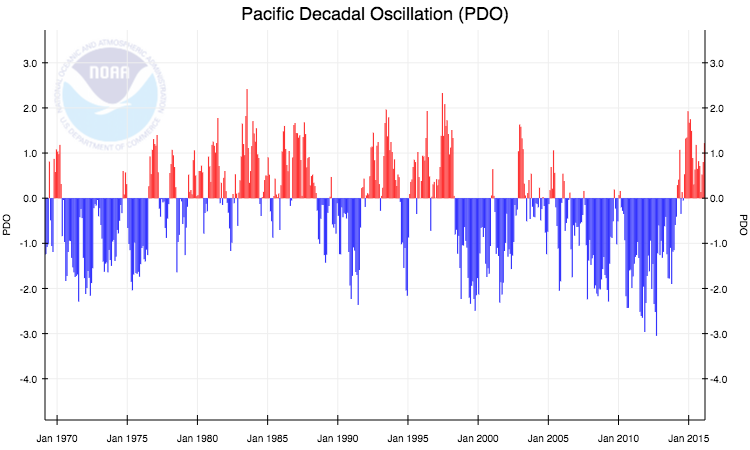 Figure 1: Monthly PDO index since about 1970 (NOAA).
Operational forecasts of the PDO from NOAA’s Climate Prediction Center (CPC) are available online (http://www.cpc.ncep.noaa.gov/products/GODAS/) as part of a Monthly Ocean Briefing hosted by CPC. The latest forecast for the PDO, using the updated CFSv2 model, is shown in Figure 3. The ensemble of forecasts from March 2016 indicates a prominent negative trend in the PDO from spring into fall 2016, with an ensemble mean value slightly into negative territory. This set of predictions is consistent with the CFSv2 ENSO forecasts (and that of many other ENSO models) that La Nina conditions are more likely to develop than not in the tropical Pacific. Will this actually come to pass? Seasonal forecasts of ENSO are far from a solved problem. For example, the ENSO models as a group poorly forecast the winter of 2014-15. On the other hand, the ENSO models for the winter of 2015-16 were spot on in their predictions of a very strong El Nino. La Nina, and a downturn in the PDO, appear probable, but only time will tell.
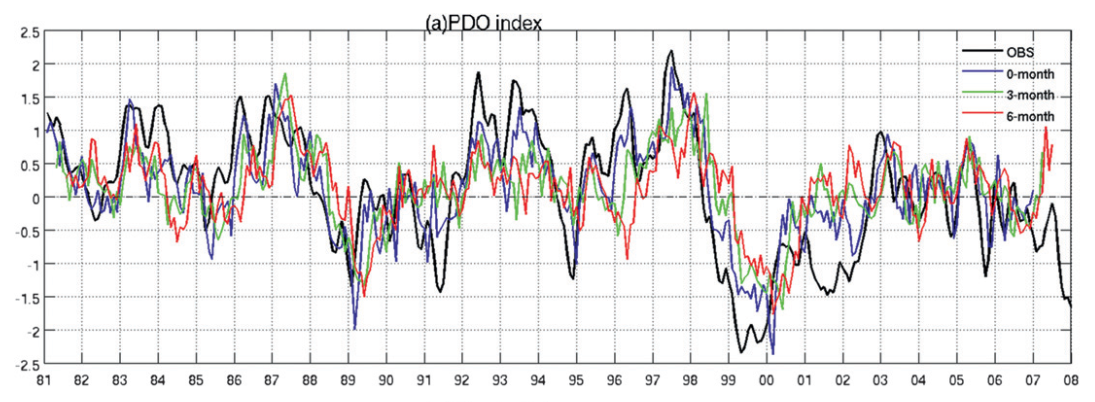 Figure 2: Observed values of the PDO versus CFS model forecasts at various lead times for the period of 1981 through 2007 (extracted from Wen et al. 2012).
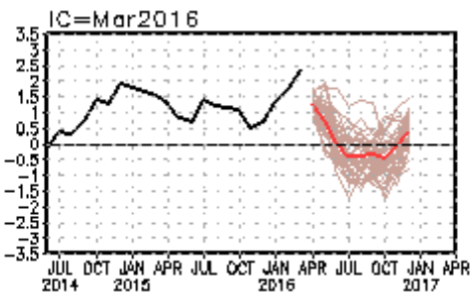 Figure 3: CFSv2 model prediction of PDO index based on March 2016 initial conditions. The bold, red line is the ensemble mean of each forecast, with the brown lines representing the 40 forecast members.
References:
Newman, M. and Co-Authors (2016): The Pacific Decadal Oscillation, Revisited. J. Clim., doi: http://dx.doi.org/10.1175/JCLI-D-15-0508.1
Wen, C.H., Y. Xue, and A. Kumar (2012): Seasonal Prediction of North Pacific SSTs and PDO in the NCEP CFS Hindcasts. J. Clim., 25, 5689–5710.