By Jacob Genuise
June was the third consecutive month with below normal precipitation statewide in Washington. June 2025 ranked in the top 10 driest Junes on record back to 1895. Statewide, precipitation averaged well below the 1991-2020 statewide average of 1.93”. The vast majority of the state experienced less than 30% of normal precipitation (dark brown shading on the precipitation map below), with 30-70% of normal precipitation measured only in small portions of the western slopes of the Cascades, northern slopes of the Olympics, and the southern I-5 corridor. Many stations fell within the top 10 driest June totals in their period of record, and large portions of eastern Washington received no measurable precipitation at all throughout the month.
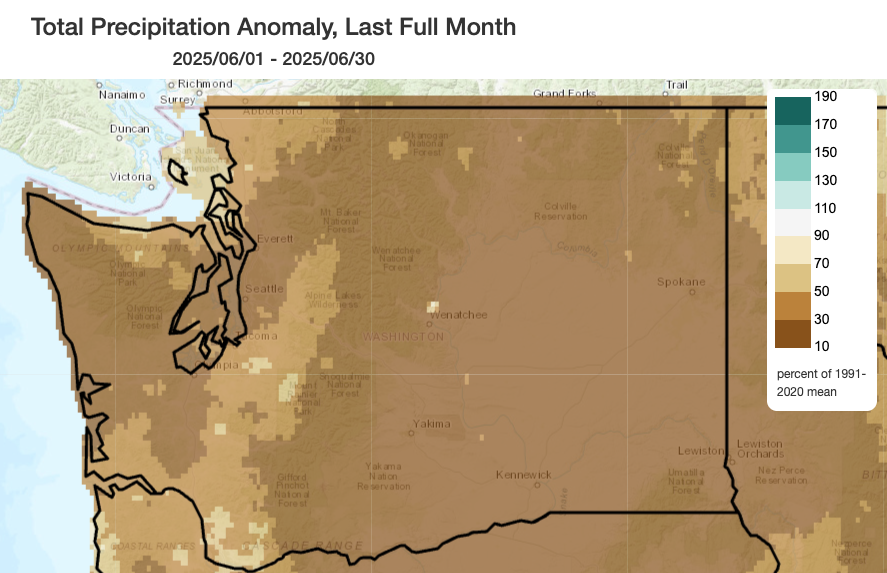 June precipitation as a percent of 1991-2020 normal.
The table below lists select stations where recorded precipitation fell within the top 10 driest June totals on record. Stations are listed in descending rank order. Pullman, Yakima, Hoquiam, Spokane, Seattle, and Olympia all ended the month within their top 10 driest Junes, which shows just how widespread the lack of precipitation was this month.
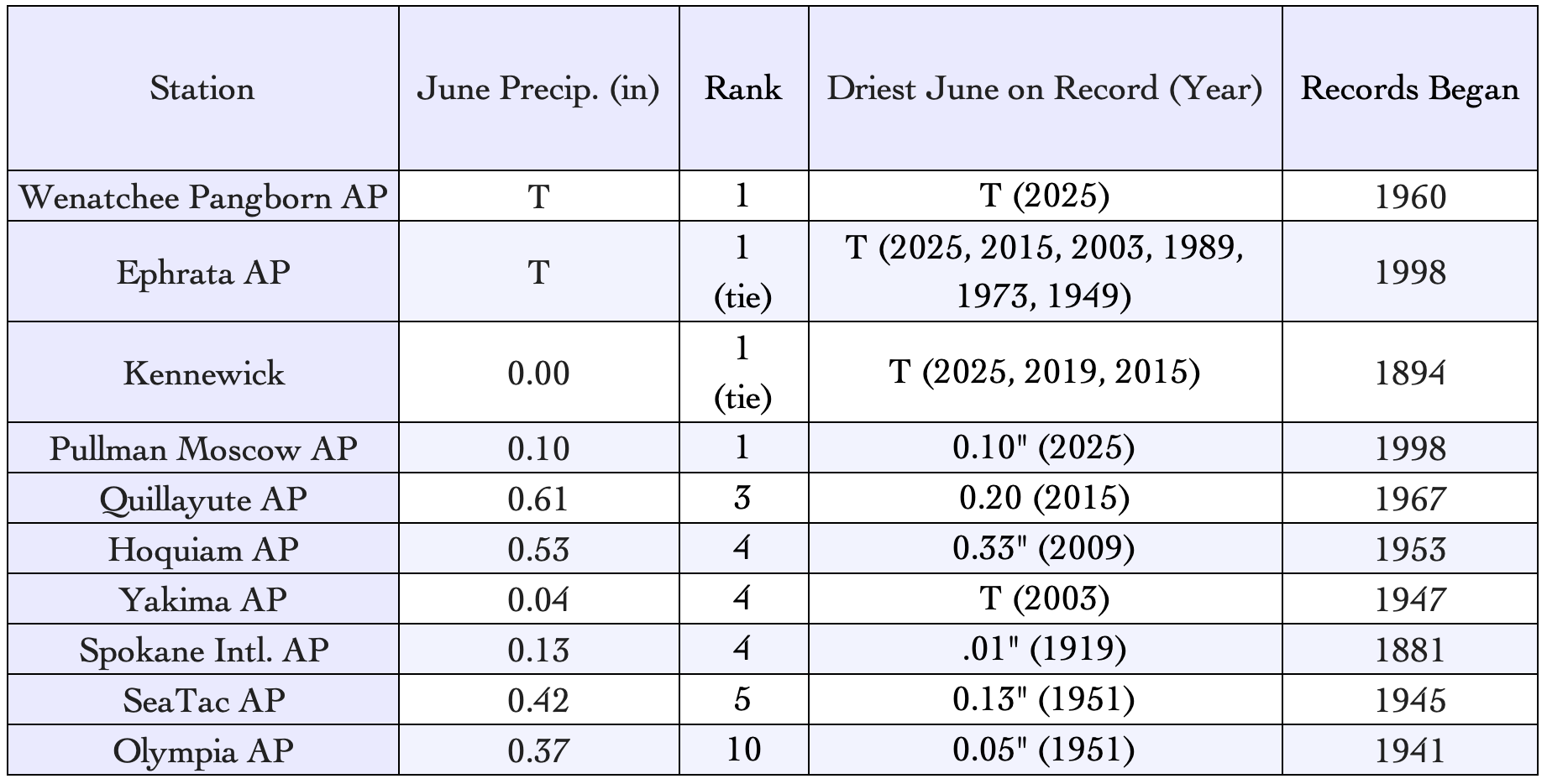 June 2025 precipitation rankings, in descending oder, for select Washington stations.
Mean temperatures for June were also well above normal statewide. The largest temperature anomalies occurred once again on the eastern slopes of the Cascades where temperatures ran 4-6°F above normal including +5.1°F in Wenatchee. Across the rest of eastern Washington, temperatures ran 3-5°F above normal including anomalies of +4.1°F in Spokane, +3.0°F in Omak, and +3.6°F in Hanford. In western Washington, most areas experienced temperatures 1-2°F above normal including the urban corridor from Olympia through Seattle. Areas right along the coast such as Quillayute (-0.2°F) and Hoquiam (-0.3°F) experienced near normal temperatures.
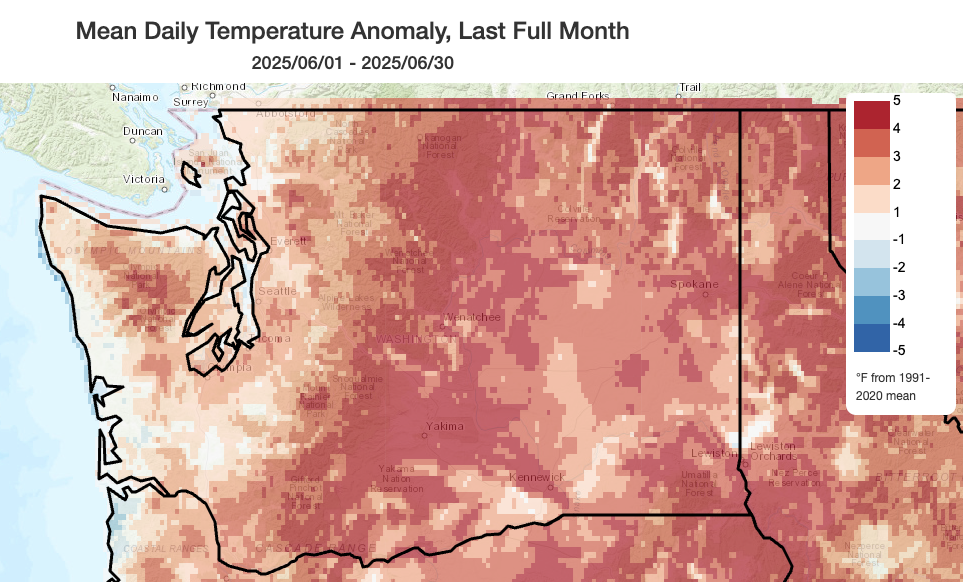 June mean temperature anomalies relative to 1991-2020 normal.
These conditions are undoubtedly an unfortunate start to the summer period, especially following a snow season that brought less than normal snowpack and a warm spring which brought earlier than average melt out.
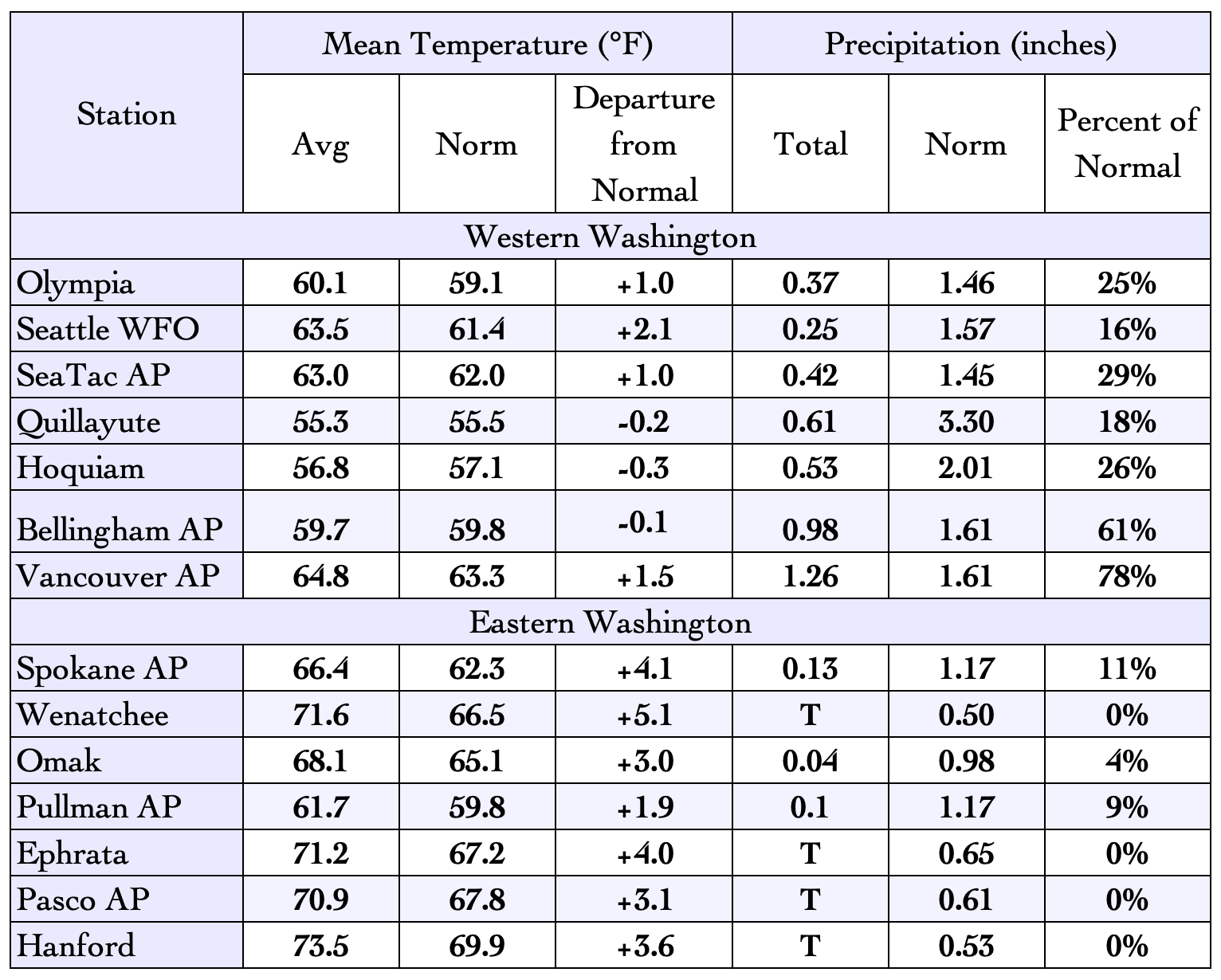 June 2025 climate summaries for locations around Washington. Anomalies are relative to a climate normal baseline of 1991-2020.