By Karin Bumbaco
The newest statewide drought declaration announced this week marks the fourth consecutive year with a drought declaration in at least some part of Washington State. With these recent droughts, WASCO has been working to better understand the myriad of ways that droughts can develop and their sector-specific impacts. One of the ways we’ve been pursuing this is by coordinating a regional Water Year Impacts Assessment.
The sixth annual assessment – the Pacific Northwest Water Year 2025 Impacts Assessment – was released this week. This assessment summarizes the weather and climate conditions around the Pacific Northwest (PNW) and reports on impacts to agriculture, drinking water, recreation, forestry, fisheries, hydropower, and stormwater from either abnormally dry or abnormally wet conditions during the water year. This report covers the last water year, which began in October 2024 and ended in September 2025.
This Climate Matters piece describes a few key highlights from the impacts section of the new report. The Assessment collects impacts from a variety of sources. One of them is our Annual PNW Water Year Impacts Survey.
We issue our survey at the end of the water year, and for the first time since this effort began six years ago, we received responses from all 119 counties in the PNW. The map below shows the number of survey responses from each county.
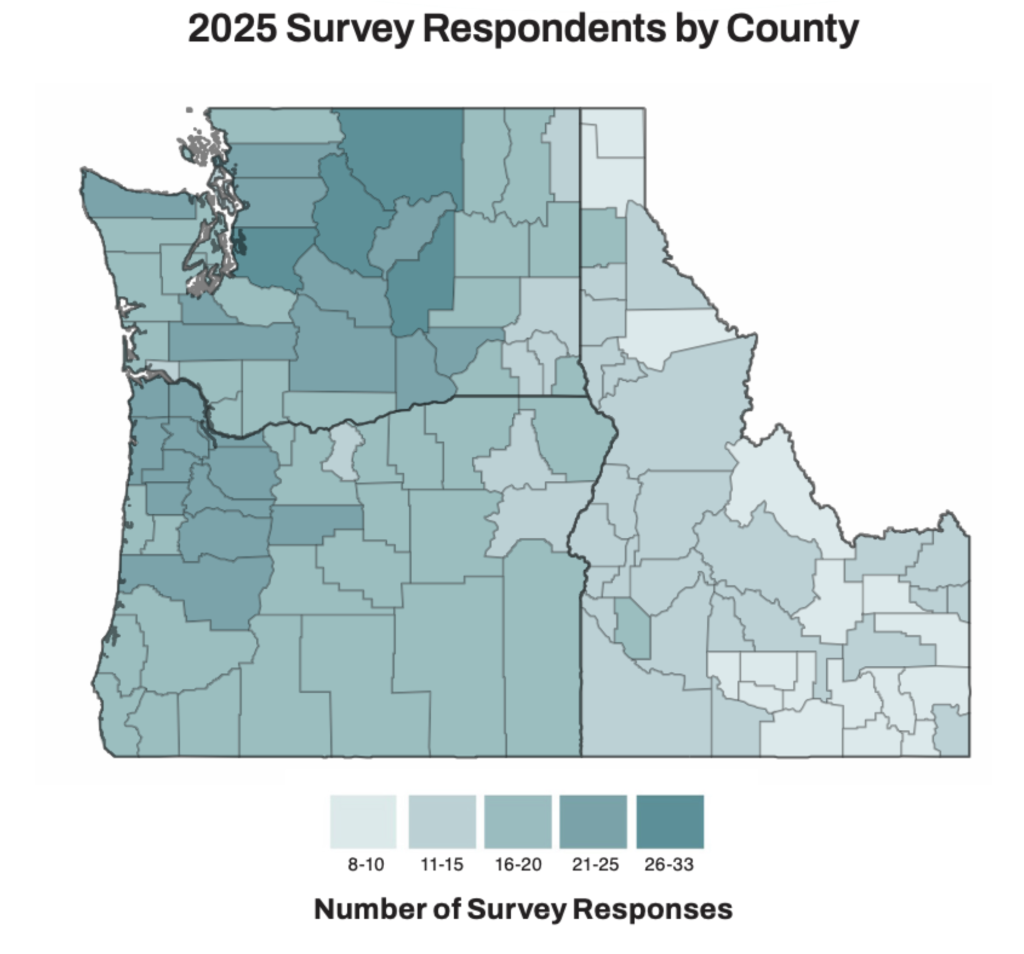 The number of PNW Water Year Impacts Survey respondents working within each county of the PNW.
Impacts from dry conditions were reported much more often than those from wet conditions over the course of the water year. Our survey received 291 reports of impacts from dry conditions and 33 reports of impacts from wet conditions. We also incorporate responses to the National Drought Mitigation Center Condition Monitoring Observer Reports (CMOR) on Drought into the Assessment. Similarly, CMOR received 79 reports related to dry conditions, 5 related to wet conditions, and 5 related to neutral conditions over the course of the water year.
The highest number of impacts from abnormally dry conditions were for the agriculture, drinking water, and forestry sectors.
Agricultural impacts culminated at the end of the water year when even senior water users in the Yakima Basin were issued water curtailments on October 6, 2025. The four major water right user categories in the Yakima Basin are senior water users, proratable water users, junior water users, and those without water rights; the Yakima basin is unique in Washington in that the water rights have been “adjudicated“, or legally defined and confirmed. While proratable and junior water users are accustomed to reduced water allocations during drought, it is unusual for senior water users to be impacted. But due to a combination of multi-year drought and a delayed start to the return of fall rains in 2025, Ecology issued a curtailment order that halted all surface water use from October 6-31 to protect the most senior water rights. This was the first time this has happened in Washington State since the water rights were adjudicated and a testament to the impacts of multi-year drought pressure on the basin. This meant that only half of the Wapato Irrigation Project demand was met after ensuring minimum required instream flows for fish. Even city and municipal water supplies were impacted by this curtailment order – not just agricultural uses.
Another impact highlighted in the Assessment came from the hydropower sector. A power provider covering eastern Washington, northern Idaho, and western Montana – whose energy portfolio is made up of about 44% hydropower – saw consistently below normal hydropower generation for January-March 2025 and May-November 2025. Annually, even including our exceptionally wet December 2025, their hydropower production was only 86% of normal. Reduced hydropower production limited their operational flexibility and required additional power purchases.
More information on these and many other impacts can be found in the PNW Water Year 2025 Impacts Assessment. As we anticipate more spring and summer drought impacts this year, you don’t have to wait until the Annual PNW Water Year Impact Survey opens next October to report drought impacts. CMOR accepts reports ranging from severely dry to severely wet conditions throughout the year, and it’s usually helpful to report impacts while they are occurring. CoCoRaHS is another way to contribute “condition reports” anytime, but you need to be an official observer (contact us if you want to sign up!). We encourage you to report any impacts you see from wet or dry conditions this year – it’s a good way to make sure your region is represented. We plan to once again roll the CMOR impacts into the upcoming 7th PNW Water Year 2026 Impacts Assessment next year. Funding for this project is provided by NOAA NIDIS, and WASCO has partnered with the UW Climate Impacts Group, Oregon Climate Service, OSU Oregon Climate Change Research Institute, and other state and federal agency partners around the PNW to carry out this annual assessment.