By Jacob Genuise
Key Messages:
- La Niña conditions remain in place, but a return to neutral conditions is expected by March.
- The February CPC outlook indicates warmer than normal temperatures are most likely statewide with slightly elevated chances of wetter than normal conditions across the northern half of the state.
- The February-April CPC outlook shows low predictability, but slightly elevated chances of cooler and wetter than normal conditions across the northeastern corner of the state.
A La Niña advisory remains in place, but tropical Pacific sea surface temperatures have warmed over the past month, and a return to neutral conditions is still expected between now and March (75% chance). The Climate Prediction Center (CPC) recently updated its ENSO indices to better reflect background sea surface temperature warming. You can read more from the CPC about why this change was made and how it impacts ENSO monitoring. This year, it slightly strengthens our current La Niña event, but we still expect it to end in the next couple of months.
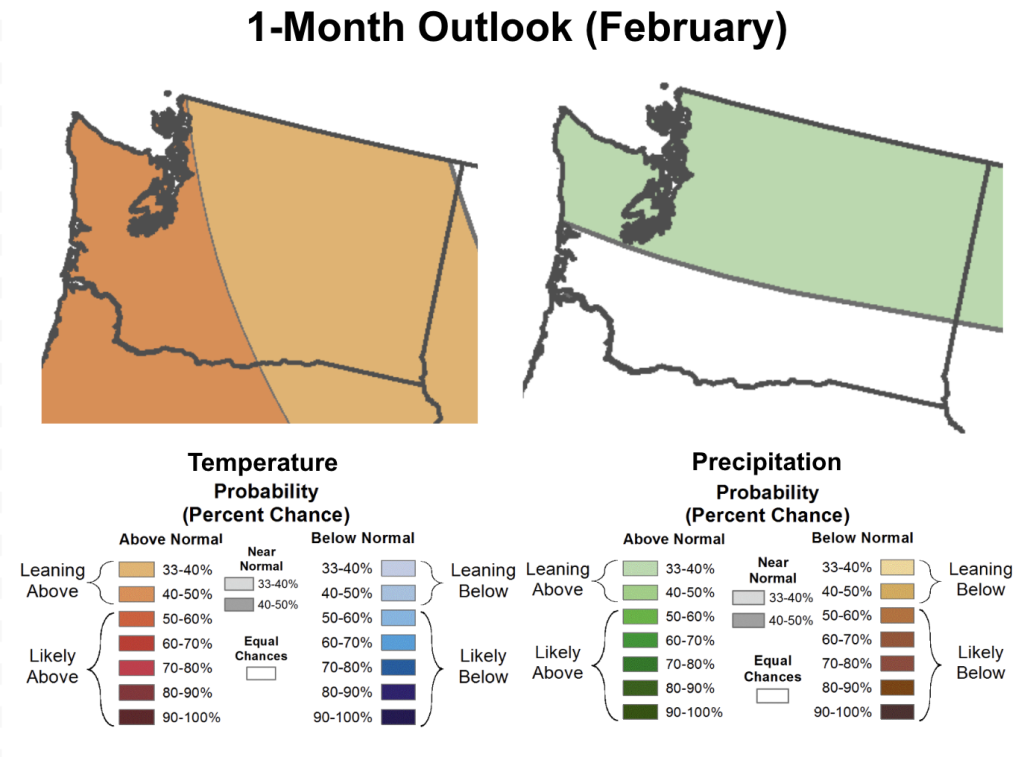 1-month (February) outlook for temperature (left) and precipitation (right) in Washington State.
The 1-Month outlook for February shows growing confidence in warmer than normal temperatures with a 40-50% chance of warmer than normal temperatures across the southwestern third of the state and a slightly lower chance (33-40%) of warmer than normal temperatures across the rest of the state. Precipitation shows generally low predictability, but the northern half of the state has slightly elevated chances (30-40%) of above normal precipitation.
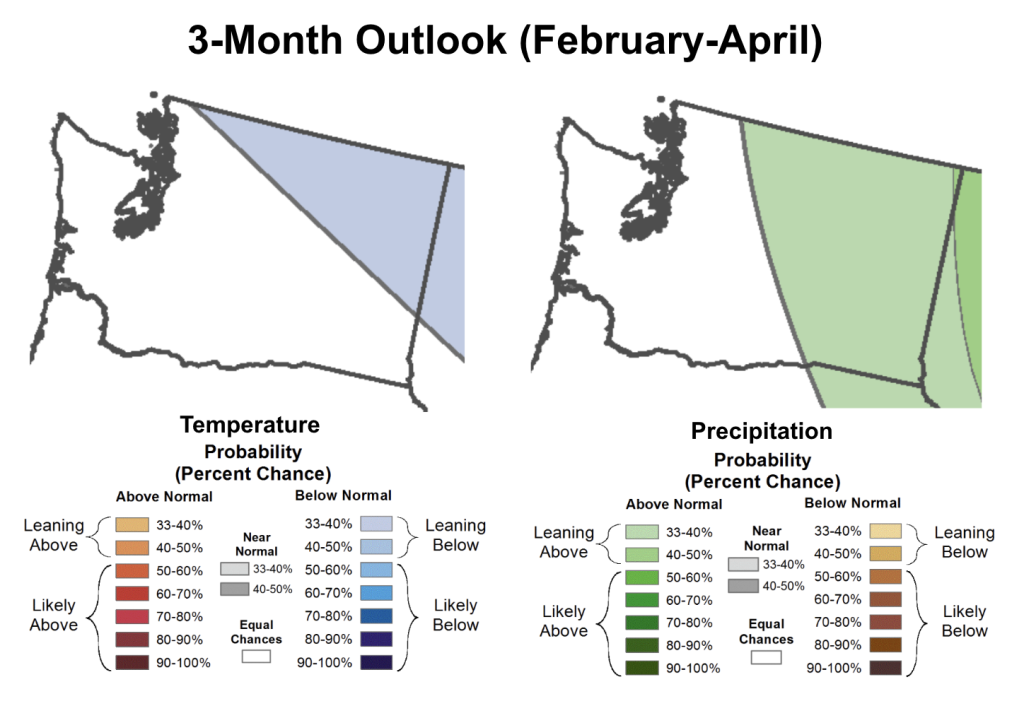 3-month (February, March, and April) outlook for temperature (left) and precipitation (right) in Washington State.
The 3-Month outlook for February through April shows slightly elevated chances (33-40%) of both cooler than normal and wetter than normal temperatures for the northeastern corner of the state. Chances of wetter than normal conditions extend a bit further than the temperature outlook, encompassing much of the central Columbia Basin and the far southeastern corner of the state. These chances are quite low and indicate low predictability over the next few months.