By Jacob Genuise
Key Messages
- La Niña conditions remain in place, likely returning to neutral conditions by January-March.
- December’s outlook indicates a slight chance of wetter than normal conditions in eastern Washington, but high uncertainty overall.
- The December-February outlook indicates cooler and wetter than normal conditions are most likely from the Cascades eastward. In western Washington, cooler than normal temperatures are most likely, but there is high uncertainty in precipitation for the period.
A La Niña advisory remains in place with a transition back to neutral conditions likely in January-March (61% chance). This year’s La Niña event continues to be relatively weak, in line with forecast guidance from earlier in the season.
The Climate Prediction Center’s outlook shows generally low confidence in precipitation and temperatures for the month of December. Across far eastern Washington in a line from near Kettle Falls to Walla Walla and to the east, there is a slightly higher chance (33-40%) of wetter than normal conditions. The 1-month temperature outlook shows equal chances of above, near, or below normal temperatures in December.
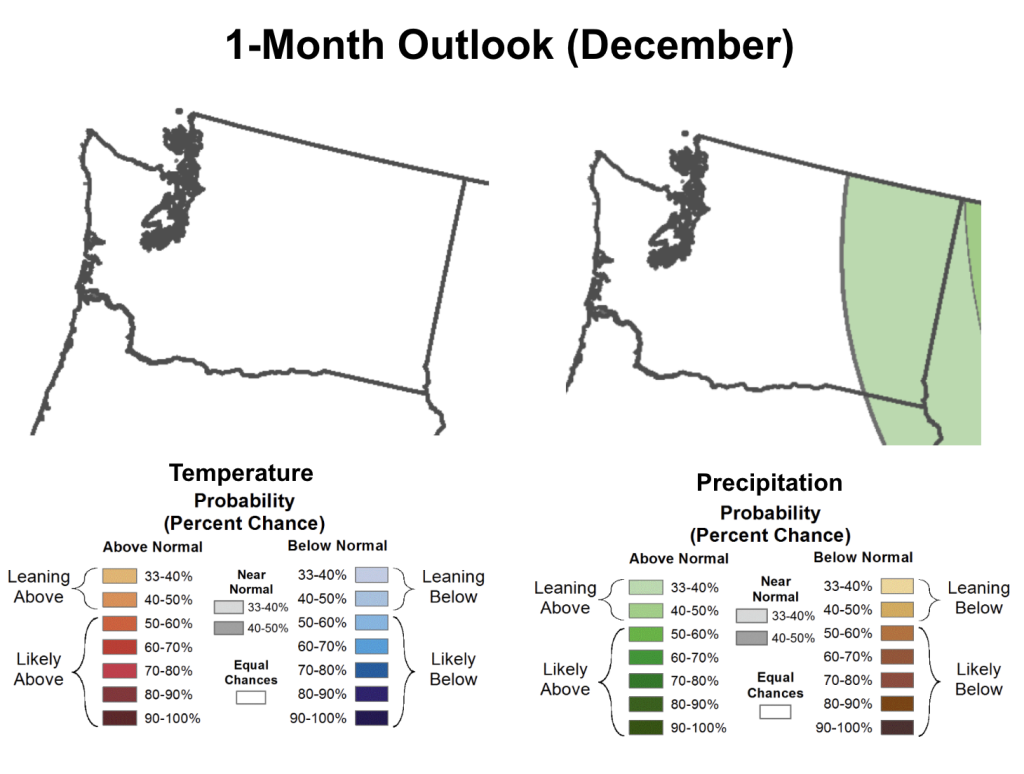 1-month (December) outlook for temperature (left) and precipitation (right) in Washington State.
The 3-Month outlook for December through February shows slightly higher confidence in wetter than normal and cooler than normal conditions across much of the state compared to the 1-Month outlook. There is a 33-40% chance of wetter than normal conditions across the central third of the state and a higher chance (40-50%) of wetter than normal conditions across the far eastern quarter of the state. In western Washington west of the Cascade foothills, there is lower confidence in precipitation outlook.
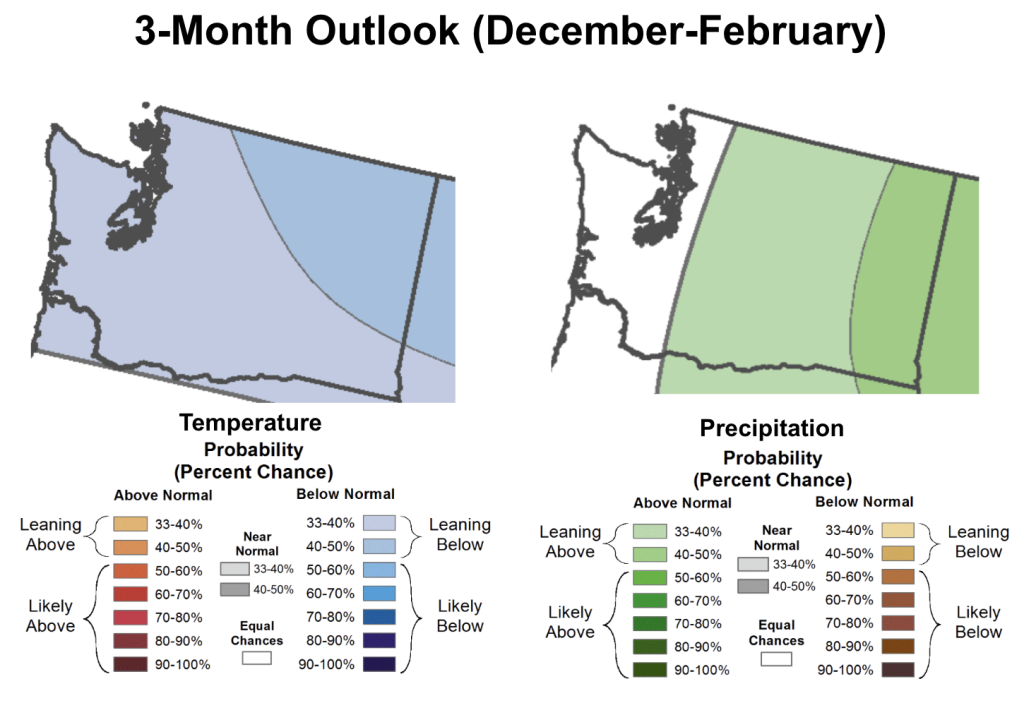 3-month (December, January, February) outlook for temperature (left) and precipitation (right) in Washington State.
There are elevated chances of below normal temperatures statewide with a 40-50% chance of below normal temperatures across the northeastern corner of the state and lower 33-40% chance of below normal temperatures elsewhere. These outlooks are largely based on mean late-winter weather conditions during past La Niña events.