By Brian J. Harvey, Associate Professor in the School of Environmental and Forest Sciences at UW
Introduction
Wildfire becomes a part of life across much of the western US this time of year, and the Pacific Northwest is no exception. The smell of smoke from fires burning hundreds of miles away or the news alerts of fires threatening nearby communities can dominate our daily routines. Although every fire season is different, we can use observations of past trends and current conditions of snowpack, weather patterns, vegetation, and ignitions to forecast what we might expect for the coming fire season.
Many people are asking whether the Pacific Northwest will experience an active fire season, particularly because snowpack from last winter through spring has been at or near historic lows. The outcome of this wildfire season depends on a combination of factors, some of which we can account for now and others that will not fully develop until later in the summer. But before we dive into what we might expect from this year’s fire season, let’s first zoom out to the broader context of fire in our region.
Fire has always been an important part of the Pacific Northwest
With recent upticks in smoke-filled summers it can be easy to think of fire in the Pacific Northwest as a relatively recent, or modern phenomenon. However, fire has shaped forests, grasslands, and shrublands in our region for as long as these ecosystems have been here. Many species are well adapted to fire, and some essentially need fire to persist. In fact, without fire, our Pacific Northwest landscapes that we all depend on would look very different. Prior to European colonization, many dry forests east of the Cascade crest experienced regular fire approximately every 5 to 35 years. Such fires removed fuel (live and dead vegetation available to burn in the next fire) and maintained open woodlands and patchy forests dominated by fire-resistant trees like ponderosa pine. Even in cooler and wetter parts of the state, forests and other ecosystems experienced fire – just at longer intervals between fire events. For example, wet and drippy old-growth forests on the Olympic peninsula are shaped by less frequent fires that can be severe, but also create opportunities for establishment of new tree seedlings and a wide diversity of plants and animals.
Fires in the Northwest historically and today are ignited by a range of causes, including natural and human-initiated. For millennia, Indigenous peoples have used cultural burning to manage landscapes for a wide variety of objectives. Today, ignitions from humans also include intentional (e.g., prescribed burns and cultural burns) and accidental (e.g., escaped campfires, sparks from vehicles or equipment) origins. Lightning ignitions contribute to a large number of fire starts, historically and through today, particularly in the late summer and early fall when vegetation and fuels are the driest and can easily ignite.
The recipe for wildfires includes several key ingredients. First, sufficient fuel is needed to carry a fire. Ecosystems throughout the Northwest typically have abundant fuel, with some areas today containing different amounts of fuel than was present historically. Second, weather conditions suitable for fire are required– the hotter and drier conditions become, the greater the wildfire potential. Add in winds and conditions become especially conducive to large and severe wildfires as fire intensity and speed increase. Third, something needs to ignite the fire. As outlined above, fires can be ignited by a variety of sources, which are generally abundant in the Northwest. Put together, if we can assume abundant fuel and ignitions, then the activity of a fire season is tied strongly to the climate leading up to, and weather conditions during, each fire season.
What climate and weather patterns drive fire seasons?
Long before the first wildfire is started, factors that make up the fire season are already at play.
Much attention is paid to the winter snowpack because across wide swaths of the western US, there is a strong relationship between winter snowpack and area burned. Snow that accumulates throughout the winter serves as a reservoir for maintaining moisture in live and dead fuels throughout the summer. Years with low winter snowpack or warm/dry springs generally lead to earlier drying of grasses, shrubs, trees, and dead fuel. Such years can cause the fire season to start earlier and are typically characterized by more area burned in wildfires.
Weather during the summer also plays a key role in the fire season. Any extended periods of hot temperature, low humidity, and strong winds can rapidly stress vegetation, dry out fuels, and fan the flames of any existing fires. Key examples of such events in recent years include the 2021 “heat dome” in the Pacific Northwest in which record-breaking temperatures persisted for multiple days, and the 2020 Labor Day Fires along the west coast of the US that were driven by strong and dry winds blowing from interior regions.
What should we expect from the 2026 fire season?
With summer weather already well underway, and the low spring snowpack melted out earlier than normal, much of the Northwest is currently experiencing above-normal significant wildland fire potential, according to the National Interagency Fire Center. In fact, in July, only a small corner of Northeast Washington and a small section of coastal SW Washington and NW Oregon are at normal significant wildland fire potential, with the remainder of Washington and Oregon above normal. By the end of the summer, the Northwest stands out as the only region in the contiguous US with widespread above-normal significant wildland fire potential.
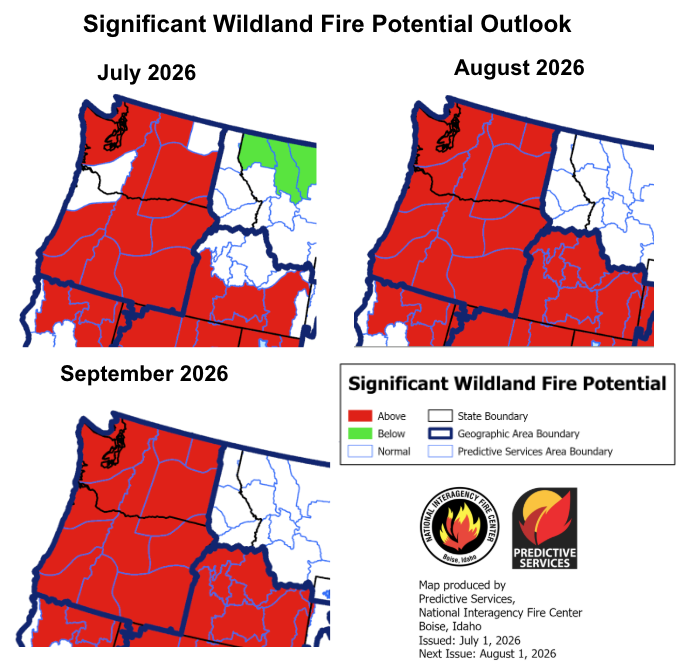 Wildfire potential outlook for July (top left), August (top right), and September (bottom left). These outlooks were created by the National Interagency Fire Center.
Given the warm and dry conditions that are typical for summer, forecasts call for all of Oregon and Washington – from the Pacific Coast to the eastern interior – to have above-normal significant wildland fire potential through August and September. Fire potential typically remains high through the very early fall until measurable precipitation begins to reliably fall in October. Importantly, late summer / early fall is also the typical time of year for strong, hot, and dry offshore wind events (think 2020 Labor Day Fires), which can coincide with the driest time of year for fuels that have cured all summer. While these strong winds can be associated with larger, more severe fires, they can only be predicted about a week in advance. So, at this point in the summer, we simply cannot say whether there will be development of strong winds later this summer in places that are susceptible to fires.
So what does this mean? For one, we all need to remain vigilant about weather conditions that are conducive to fire throughout the fire season. Minimizing or eliminating any unwanted and unplanned ignitions is important, especially when conditions are forecast to be hot, dry, and windy. Conditions can change quickly; so even if it is a relatively mild week, there could be a heat wave or wind event right around the corner. Two, recognize that wildfires are a part of Northwest landscapes – it is not a question of if, but when fires will burn. That means it’s important to have plans in place for what to do in the event of a wildfire. Emergency contacts, evacuation routes, safeguarding of irreplaceable items, and ensuring access to clean air during smoky periods are all important. Finally, learn more about preparing for fire in your community and about the ways that you can make your home or property more resistant to fire. Good examples are the King County Wildfire Risk Reduction Strategy or programs such as Firewise USA.
Looking ahead beyond this fire season
Although wildfire activity in the Northwest (or more broadly across western North America) can be variable from year-to-year, the last 3 decades have seen consistent trends in rising temperatures, reduced snowpack, and more active wildfire seasons. Scientists expect these trends to continue into the future, meaning that wildfire is likely to become more and more common. However, it is important to remember that wildfire and intentional use of fire as a management tool are both normal and essential pieces of Pacific Northwest landscapes. In fact, many forested areas in the Northwest experience much less fire today than they did for most of the last several millennia – meaning that some of the larger fire years in recent memory are actually more typical of how much area burned in the past.
Learning to live sustainably with fire and reducing risk of the negative impacts from wildfire will require many complementary approaches, including prescribed burns and fuel reduction treatments where appropriate, preparing communities and infrastructure, and collaborative cooperation between private landowners, public agencies, and Tribal nations to manage wildfires that know no borders.
Data used
Monthly wildfire outlooks were referenced from the National Interagency Fire Center.